
The game Cash or Crash Live carves its own space in the live game show world. Its appeal is found in a potent mix of stage show and game rules that turns every round into a personal test of nerve. This is no a passive spin of a roulette table. In this game, you are in control, making active choices that directly control what you win. The idea draws you in with an increasing multiplier, then urges you to cash out before a hidden “crash” resets everything. To get the most out of the game, you must ignore the glitz and see how it actually works. Let’s examine the rounds, the host’s role, the odds involved, and what players can realistically do to steer through the excitement.
Finale: A Blend of Luck and Choice
Cash or Crash Live is a intriguing combination of pure luck and deliberate choice. Its workings are designed to weave a narrative of rising tension, fueled by a transparent RNG and animated by a charming presenter. Measuring victory as a enjoyable and potentially rewarding session relies on various elements. It’s less about predicting the unpredictable and more about grasping how the game is built. It demands managing your funds with discipline and managing the mental impulses the game masterfully triggers. By learning its levels, acknowledging its mathematical foundation, and sticking to a individual strategy, you can alter your outlook. You transition from puzzled guesswork to informed involvement in a remarkably thrilling live game show.
The function of the live host and RNG
The on-air host goes beyond talk. They set the game’s emotional pace. While they can’t affect the result, they skillfully build suspense. They call out the climbing multiplier and offer live updates on what percentage of the crowd is cashing out at each level. That social cue can mess with your head. But remember, the host operates independently of the game’s engine: the Random Number Generator (RNG). The crash point for each stage is established by a certified RNG the instant the stage begins. This ensures fairness and total unpredictability. The host has no clue when the crash will happen. Their job is entertainment. The RNG’s job is certifiable fairness. This combination blends transparent live action with provably random results.
Statistical Underpinnings and Risk
Let’s consider the figures that make the game tick. The crash point for each stage comes from a set statistical distribution. Common, lower multipliers like 1.2x or 1.5x are very likely to occur. Sky-high multipliers are achievable, but are exponentially more rare. This system ensures the game stable. The regular, small crashes finance the infrequent, massive possible wins. The RTP figure is a theoretical percentage over millions of plays. In a single gaming session, the fluctuations are dramatic. You’re not playing against the casino in a traditional way. You’re acting against a secret, unpredictable number. Keep these points in mind:
- Separate Rounds: Every round’s crash point is an independent occurrence. A crash of 1.2x in round one gives no info about round two.
- No Forecasting Ability: The random number generator ensures no predictable sequences. Previous crashes or large wins do not affect future rounds.
- Casino Margin: The system incorporates a house advantage, as reflected in the publicly stated RTP from the developer.
The Core Objective and Basic Flow
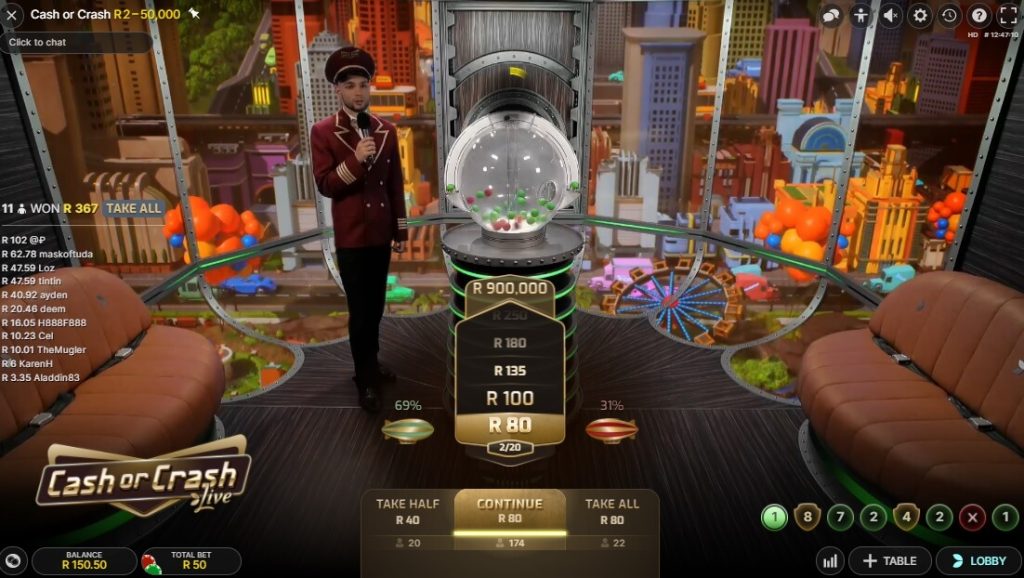
The goal of Cash or Crash Live is straightforward on the appearance. You need to determine when to withdraw a growing multiplier before a concealed “crash point” ends the game and takes your profits for that level. Each game begins with players making bets. A rocket then begins its ascent, and a multiplier starts climbing from 1x. The trip has multiple levels. Pre-launch, a unknown crash multiplier is set for every stage, hidden from nobody. As the number increases, each player chooses to hit “Cash Out,” fixing that multiplier on their bet, or to stay on board. If the rocket hits the secret crash point prior to a player exits, they surrender their wager for that phase. This cycle of risk and reward repeats over several phases. Those who endure grow their winnings step by step.
Deconstructing the Game Stages
Think of the game as a series of different chapters, each a new risk cashorcrashcasino.com. Surviving a crash doesn’t knock you out. You advance to the following stage with your accumulated winnings intact, then commence the gambling process from scratch on the next segment of the rocket’s flight. This framework is everything. It creates a narrative, with pressure that builds as you progress. The announcer heightens the tension, announcing how many players are still aboard the rocket as the multiplier achieves frightening values. Early stages often feature cautious plays. Advanced rounds, with their jackpot-level multipliers, lure you to risk the winnings you’ve already secured. This segmentation is the heart of the game’s appeal. It forces a sequence of independent, stressful decisions instead of a single one.
From Low to High Risk: The Increasing Danger
Notice the color-coded path the rocket travels. It’s a fundamental part of the game’s language. The initial section is typically a “Green Zone,” a less dangerous phase where a crash is still a possibility. Afterward, the rocket might reach an “Amber Zone,” a clear signal that risk is rising. The concluding section is the “Red Zone.” At this point, multipliers are their most attractive, but the probability of a crash is numerically at its highest. Those hues are not just decoration. They provide a visual shorthand for the hazard level at any given time. They turn an intangible probability feel concrete. Knowing the game is deliberately warning you about rising risk is a essential piece of strategic information.
Tactical Approaches and User Behavior
No tactic can beat the core randomness. But you can use systematic techniques to manage your funds and your mental state. The main conflict is a trade-off. Do you secure assured gains, or aim for massive gains? Gamblers often employ techniques like the “Fixed Cash-Out.” With this approach, you decide ahead of time to cash out at a particular multiplier, say 2x, in every phase. This aims for consistent, small profits. The opposite is the “Let It Ride” method, where you wager multiple stages for a chance at a massive win, recognizing that failures will take place. A more strategic tactic is the “Percentage Bankroll” technique, where you modify your stake based on your current winnings. The biggest factor, though, is in your head. Can you overcome the “greed factor” when the multiplier rises? Can you avoid frustration after an initial failure? Your most powerful tool is creating strict rules for yourself before the game even begins.
Common Pitfalls to Steer Clear Of
Watch out for a few common errors. The most harmful is “chasing” a crash. This means rashly raising your wager after a defeat, which contradicts the system’s stage-independent nature. Another error is falling for the “hot hand” fallacy, believing a sequence of high multipliers is expected to continue. Allowing the host’s chatter or the behavior of other participants divert you from your own established approach is common. Also, avoid misinterpreting the zones. The Amber and Red Zones are not tests to beat. They are warnings that the hazard has spiked. Entering any round without a specific aim turns the activity from a series of choices into a complete emotional journey. That experience rarely ends well.